How to train around your cycle with JOIN’s Period Tracker
Jul 31, 2026

How to train around your cycle with JOIN’s Period Tracker
Jul 31, 2026
How to train around your cycle with JOIN’s Period Tracker
Jul 31, 2026
Training does not happen in a vacuum. Sleep, stress, work, nutrition and recovery can all change how a workout feels. For many cyclists, menstrual symptoms are another important part of that picture. Some days, your usual Threshold session feels completely manageable. On others, cramps, fatigue, headaches or heavy bleeding can make the same effort feel much harder. That does not mean you need a rigid training plan for every phase of your cycle. It means your plan should be able to respond to how you actually feel. That is exactly what JOIN’s Period Tracker is designed to do.
Training does not happen in a vacuum. Sleep, stress, work, nutrition and recovery can all change how a workout feels. For many cyclists, menstrual symptoms are another important part of that picture. Some days, your usual Threshold session feels completely manageable. On others, cramps, fatigue, headaches or heavy bleeding can make the same effort feel much harder. That does not mean you need a rigid training plan for every phase of your cycle. It means your plan should be able to respond to how you actually feel. That is exactly what JOIN’s Period Tracker is designed to do.
Training does not happen in a vacuum. Sleep, stress, work, nutrition and recovery can all change how a workout feels. For many cyclists, menstrual symptoms are another important part of that picture. Some days, your usual Threshold session feels completely manageable. On others, cramps, fatigue, headaches or heavy bleeding can make the same effort feel much harder. That does not mean you need a rigid training plan for every phase of your cycle. It means your plan should be able to respond to how you actually feel. That is exactly what JOIN’s Period Tracker is designed to do.

JOIN amène votre pratique du cyclisme au niveau supérieur
Vous cherchez une façon plus intelligente de vous entraîner ? JOIN crée des programmes de cyclisme personnalisés en fonction de vos objectifs et de votre progression, garantissant que vous êtes toujours sur la bonne voie.
JOIN amène votre pratique du cyclisme au niveau supérieur
Vous cherchez une façon plus intelligente de vous entraîner ? JOIN crée des programmes de cyclisme personnalisés en fonction de vos objectifs et de votre progression, garantissant que vous êtes toujours sur la bonne voie.
JOIN amène votre pratique du cyclisme au niveau supérieur
Vous cherchez une façon plus intelligente de vous entraîner ? JOIN crée des programmes de cyclisme personnalisés en fonction de vos objectifs et de votre progression, garantissant que vous êtes toujours sur la bonne voie.
Your cycle can affect training, but not in the same way for everyone
You may have seen advice suggesting that every athlete should train hard during one phase of the menstrual cycle and reduce intensity during another. The science is not that simple. A large systematic review found that exercise performance may be slightly reduced during the early follicular phase, which begins with menstruation. However, the average effect was small, the quality of the available evidence was limited and responses varied considerably between individuals (McNulty et al.). More recent expert guidance reaches a similar conclusion: there is not enough consistent evidence to prescribe the same phase-based training schedule to everyone. Tracking is most valuable when it helps athletes understand their own symptoms, patterns and needs rather than following assumptions about what they should be capable of on a particular cycle day (Verhagen et al.). In practice, two cyclists can experience the same phase very differently. One may complete a hard workout without any problems, while another experiences cramps, low energy or difficulty concentrating. Even your own experience may vary from one month to the next. That is why JOIN focuses on your input.
What is JOIN’s Period Tracker?
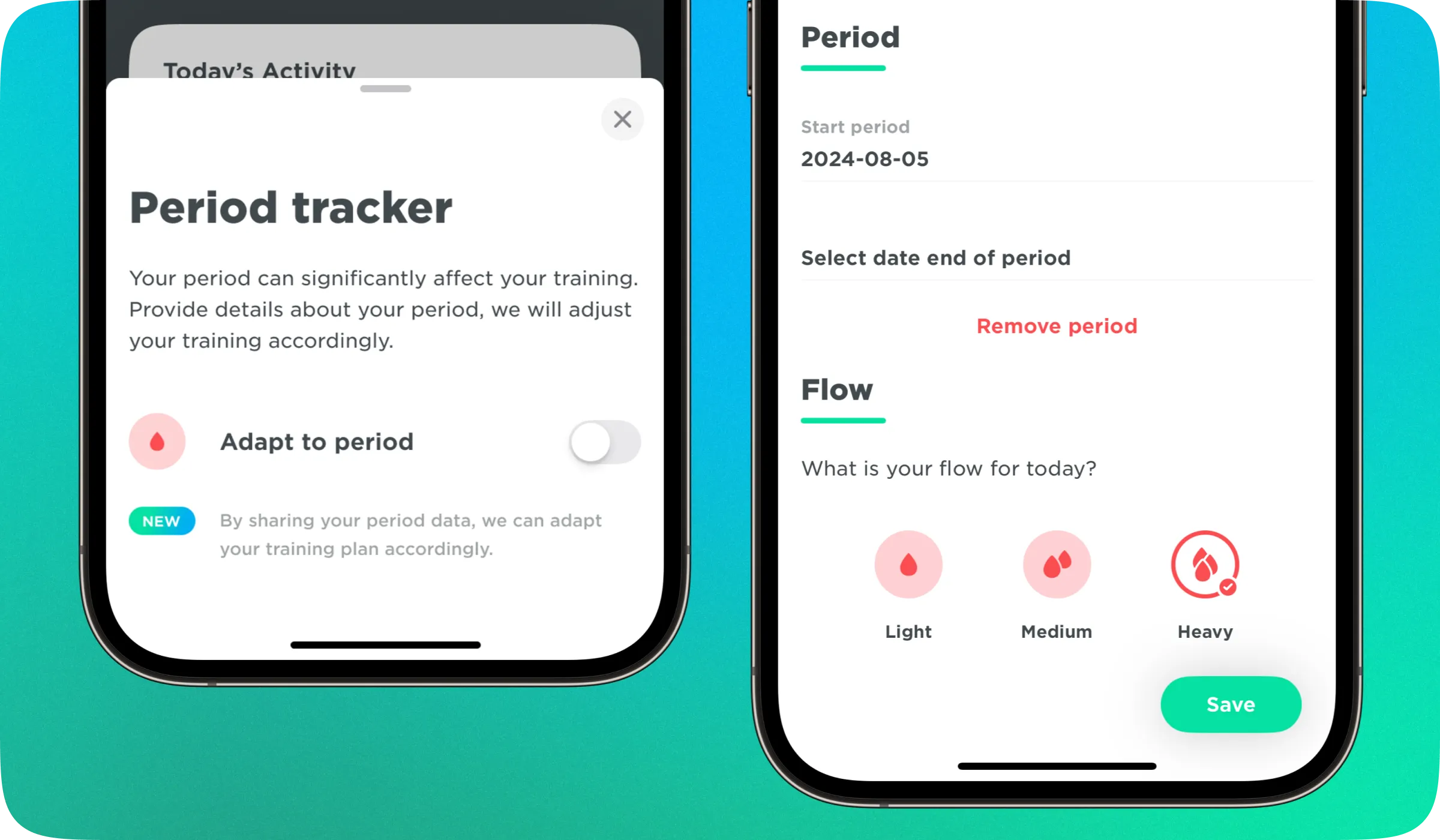
JOIN’s Period Tracker allows you to record information about your period and the discomfort you experience throughout your cycle. JOIN combines that information with your training data and may adjust your upcoming workout when necessary. You can log:
The start and end of your period
Your daily flow as light, medium or heavy
Your level of discomfort as none, moderate or a lot
Discomfort can be entered at any point in your cycle. You do not need to wait until your period begins. Logging symptoms as soon as they appear gives JOIN a more accurate picture of how you feel today.
How JOIN adapts your training
The Period Tracker does not automatically assume that you need an easier workout simply because you are menstruating. Instead, it uses the discomfort level you report.
No discomfort
When you feel fine, your regular training intensity is maintained, with only minor adjustments when needed.
Moderate discomfort
JOIN may suggest a toned-down workout. You can still train, but the session places less strain on your body.
A lot of discomfort
When symptoms are significant, JOIN may replace the planned session with an easy spin or a complete rest day. This symptom-led approach helps you avoid two common mistakes: pushing through a demanding workout when your body needs recovery, or unnecessarily reducing your training because an app assumes everyone responds to the menstrual cycle in the same way.
How to enable the Period Tracker
You can enable the feature from your Health Profile:
Open JOIN.
Tap the Settings icon.
Open Health Profile.
Set your gender to Female.
Toggle the Period Tracker on.
Once enabled, the Period tracker can be accessed by tapping Readiness button on the Home tab. Tap it whenever you want to add or update your information.
How to get the most from it
Log consistently
One entry gives JOIN information about one day. Regular entries help create a more complete picture. Record the beginning and end of your period, update your flow and log discomfort whenever symptoms change. Consistent tracking can also help you identify personal patterns over time.
Track symptoms, not assumptions
Do not reduce your training simply because a particular cycle day is supposed to be difficult. When you feel strong, follow the workout. When symptoms affect your ability to train, log them honestly and allow JOIN to respond. Current evidence supports an individualized approach rather than applying one universal cycle-based programme to every athlete (McNulty et al.; Verhagen et al.).
Be honest about discomfort
Do not treat moderate or severe discomfort as a lack of motivation. Cramps, fatigue and other symptoms can affect focus, perceived effort and the ability to complete planned training. Studies involving athletes show that many experience menstrual symptoms that influence their participation or perceived performance, although the type and severity vary widely (Carmichael et al.). Logging how you feel gives JOIN useful context. It is not an excuse to avoid training; it is information that helps make the training more appropriate.
Keep fueling and recovery in the picture
Not every difficult workout is caused by your menstrual cycle. Poor sleep, stress, dehydration, inadequate carbohydrate intake and accumulated fatigue can all contribute.Use the Period Tracker alongside the other feedback you provide JOIN, including readiness, recovery and RPE. The goal is not to explain every bad day through your cycle. It is to give your plan another relevant piece of information.
Your cycle is also a health signal
Tracking is not only useful for adapting workouts. Changes in your cycle can sometimes indicate that something else requires attention. Persistent cycle irregularities or absent periods in athletes may be associated with low energy availability, where the body does not receive enough energy to support both training and normal physiological functions. Over time, this can affect reproductive function, recovery and bone health (Mountjoy et al.; De Souza et al.). Missing periods should therefore not automatically be viewed as a normal result of training hard. Speak with a qualified medical professional when you experience persistent changes, unusually heavy bleeding, severe pain or symptoms that regularly interfere with everyday life or training.
Train with your body, not against it
There is no perfect workout schedule that applies to every menstrual cycle and every cyclist. The most useful approach is awareness: understand your patterns, record how you feel and adapt when symptoms genuinely affect your ability to train. JOIN’s Period Tracker makes that part of your training plan. When you feel good, you can keep progressing. When your body needs something different, your plan can respond. Because effective training is not about forcing every planned workout at any cost. It is about applying the right training at the right time, and giving your body what it needs to keep moving forward.
Works Cited
Carmichael, Melissa A., et al. “The Impact of Menstrual Cycle Phase on Athletes’ Performance: A Narrative Review.” International Journal of Environmental Research and Public Health, vol. 18, no. 4, 2021, article 1667.
McNulty, Kelly Lee, et al. “The Effects of Menstrual Cycle Phase on Exercise Performance in Eumenorrheic Women: A Systematic Review and Meta-Analysis.” Sports Medicine, vol. 50, no. 10, 2020, pp. 1813–27. doi:10.1007/s40279-020-01319-3.
Mountjoy, Margo, et al. “2023 International Olympic Committee’s Consensus Statement on Relative Energy Deficiency in Sport.” British Journal of Sports Medicine, vol. 57, no. 17, 2023, pp. 1073–97. doi:10.1136/bjsports-2023-106994.
Verhagen, Evert, et al. “UEFA Consensus Statement on Menstrual Cycle Tracking in Women’s Football.” BMJ Open Sport & Exercise Medicine, vol. 11, no. 3, 2025, article e002769. doi:10.1136/bmjsem-2025-002769.
Your cycle can affect training, but not in the same way for everyone
You may have seen advice suggesting that every athlete should train hard during one phase of the menstrual cycle and reduce intensity during another. The science is not that simple. A large systematic review found that exercise performance may be slightly reduced during the early follicular phase, which begins with menstruation. However, the average effect was small, the quality of the available evidence was limited and responses varied considerably between individuals (McNulty et al.). More recent expert guidance reaches a similar conclusion: there is not enough consistent evidence to prescribe the same phase-based training schedule to everyone. Tracking is most valuable when it helps athletes understand their own symptoms, patterns and needs rather than following assumptions about what they should be capable of on a particular cycle day (Verhagen et al.). In practice, two cyclists can experience the same phase very differently. One may complete a hard workout without any problems, while another experiences cramps, low energy or difficulty concentrating. Even your own experience may vary from one month to the next. That is why JOIN focuses on your input.
What is JOIN’s Period Tracker?
JOIN’s Period Tracker allows you to record information about your period and the discomfort you experience throughout your cycle. JOIN combines that information with your training data and may adjust your upcoming workout when necessary. You can log:
The start and end of your period
Your daily flow as light, medium or heavy
Your level of discomfort as none, moderate or a lot
Discomfort can be entered at any point in your cycle. You do not need to wait until your period begins. Logging symptoms as soon as they appear gives JOIN a more accurate picture of how you feel today.
How JOIN adapts your training
The Period Tracker does not automatically assume that you need an easier workout simply because you are menstruating. Instead, it uses the discomfort level you report.
No discomfort
When you feel fine, your regular training intensity is maintained, with only minor adjustments when needed.
Moderate discomfort
JOIN may suggest a toned-down workout. You can still train, but the session places less strain on your body.
A lot of discomfort
When symptoms are significant, JOIN may replace the planned session with an easy spin or a complete rest day. This symptom-led approach helps you avoid two common mistakes: pushing through a demanding workout when your body needs recovery, or unnecessarily reducing your training because an app assumes everyone responds to the menstrual cycle in the same way.
How to enable the Period Tracker
You can enable the feature from your Health Profile:
Open JOIN.
Tap the Settings icon.
Open Health Profile.
Set your gender to Female.
Toggle the Period Tracker on.
Once enabled, the Period tracker can be accessed by tapping Readiness button on the Home tab. Tap it whenever you want to add or update your information.
How to get the most from it
Log consistently
One entry gives JOIN information about one day. Regular entries help create a more complete picture. Record the beginning and end of your period, update your flow and log discomfort whenever symptoms change. Consistent tracking can also help you identify personal patterns over time.
Track symptoms, not assumptions
Do not reduce your training simply because a particular cycle day is supposed to be difficult. When you feel strong, follow the workout. When symptoms affect your ability to train, log them honestly and allow JOIN to respond. Current evidence supports an individualized approach rather than applying one universal cycle-based programme to every athlete (McNulty et al.; Verhagen et al.).
Be honest about discomfort
Do not treat moderate or severe discomfort as a lack of motivation. Cramps, fatigue and other symptoms can affect focus, perceived effort and the ability to complete planned training. Studies involving athletes show that many experience menstrual symptoms that influence their participation or perceived performance, although the type and severity vary widely (Carmichael et al.). Logging how you feel gives JOIN useful context. It is not an excuse to avoid training; it is information that helps make the training more appropriate.
Keep fueling and recovery in the picture
Not every difficult workout is caused by your menstrual cycle. Poor sleep, stress, dehydration, inadequate carbohydrate intake and accumulated fatigue can all contribute.Use the Period Tracker alongside the other feedback you provide JOIN, including readiness, recovery and RPE. The goal is not to explain every bad day through your cycle. It is to give your plan another relevant piece of information.
Your cycle is also a health signal
Tracking is not only useful for adapting workouts. Changes in your cycle can sometimes indicate that something else requires attention. Persistent cycle irregularities or absent periods in athletes may be associated with low energy availability, where the body does not receive enough energy to support both training and normal physiological functions. Over time, this can affect reproductive function, recovery and bone health (Mountjoy et al.; De Souza et al.). Missing periods should therefore not automatically be viewed as a normal result of training hard. Speak with a qualified medical professional when you experience persistent changes, unusually heavy bleeding, severe pain or symptoms that regularly interfere with everyday life or training.
Train with your body, not against it
There is no perfect workout schedule that applies to every menstrual cycle and every cyclist. The most useful approach is awareness: understand your patterns, record how you feel and adapt when symptoms genuinely affect your ability to train. JOIN’s Period Tracker makes that part of your training plan. When you feel good, you can keep progressing. When your body needs something different, your plan can respond. Because effective training is not about forcing every planned workout at any cost. It is about applying the right training at the right time, and giving your body what it needs to keep moving forward.
Works Cited
Carmichael, Melissa A., et al. “The Impact of Menstrual Cycle Phase on Athletes’ Performance: A Narrative Review.” International Journal of Environmental Research and Public Health, vol. 18, no. 4, 2021, article 1667.
McNulty, Kelly Lee, et al. “The Effects of Menstrual Cycle Phase on Exercise Performance in Eumenorrheic Women: A Systematic Review and Meta-Analysis.” Sports Medicine, vol. 50, no. 10, 2020, pp. 1813–27. doi:10.1007/s40279-020-01319-3.
Mountjoy, Margo, et al. “2023 International Olympic Committee’s Consensus Statement on Relative Energy Deficiency in Sport.” British Journal of Sports Medicine, vol. 57, no. 17, 2023, pp. 1073–97. doi:10.1136/bjsports-2023-106994.
Verhagen, Evert, et al. “UEFA Consensus Statement on Menstrual Cycle Tracking in Women’s Football.” BMJ Open Sport & Exercise Medicine, vol. 11, no. 3, 2025, article e002769. doi:10.1136/bmjsem-2025-002769.
Your cycle can affect training, but not in the same way for everyone
You may have seen advice suggesting that every athlete should train hard during one phase of the menstrual cycle and reduce intensity during another. The science is not that simple. A large systematic review found that exercise performance may be slightly reduced during the early follicular phase, which begins with menstruation. However, the average effect was small, the quality of the available evidence was limited and responses varied considerably between individuals (McNulty et al.). More recent expert guidance reaches a similar conclusion: there is not enough consistent evidence to prescribe the same phase-based training schedule to everyone. Tracking is most valuable when it helps athletes understand their own symptoms, patterns and needs rather than following assumptions about what they should be capable of on a particular cycle day (Verhagen et al.). In practice, two cyclists can experience the same phase very differently. One may complete a hard workout without any problems, while another experiences cramps, low energy or difficulty concentrating. Even your own experience may vary from one month to the next. That is why JOIN focuses on your input.
What is JOIN’s Period Tracker?
JOIN’s Period Tracker allows you to record information about your period and the discomfort you experience throughout your cycle. JOIN combines that information with your training data and may adjust your upcoming workout when necessary. You can log:
The start and end of your period
Your daily flow as light, medium or heavy
Your level of discomfort as none, moderate or a lot
Discomfort can be entered at any point in your cycle. You do not need to wait until your period begins. Logging symptoms as soon as they appear gives JOIN a more accurate picture of how you feel today.
How JOIN adapts your training
The Period Tracker does not automatically assume that you need an easier workout simply because you are menstruating. Instead, it uses the discomfort level you report.
No discomfort
When you feel fine, your regular training intensity is maintained, with only minor adjustments when needed.
Moderate discomfort
JOIN may suggest a toned-down workout. You can still train, but the session places less strain on your body.
A lot of discomfort
When symptoms are significant, JOIN may replace the planned session with an easy spin or a complete rest day. This symptom-led approach helps you avoid two common mistakes: pushing through a demanding workout when your body needs recovery, or unnecessarily reducing your training because an app assumes everyone responds to the menstrual cycle in the same way.
How to enable the Period Tracker
You can enable the feature from your Health Profile:
Open JOIN.
Tap the Settings icon.
Open Health Profile.
Set your gender to Female.
Toggle the Period Tracker on.
Once enabled, the Period tracker can be accessed by tapping Readiness button on the Home tab. Tap it whenever you want to add or update your information.
How to get the most from it
Log consistently
One entry gives JOIN information about one day. Regular entries help create a more complete picture. Record the beginning and end of your period, update your flow and log discomfort whenever symptoms change. Consistent tracking can also help you identify personal patterns over time.
Track symptoms, not assumptions
Do not reduce your training simply because a particular cycle day is supposed to be difficult. When you feel strong, follow the workout. When symptoms affect your ability to train, log them honestly and allow JOIN to respond. Current evidence supports an individualized approach rather than applying one universal cycle-based programme to every athlete (McNulty et al.; Verhagen et al.).
Be honest about discomfort
Do not treat moderate or severe discomfort as a lack of motivation. Cramps, fatigue and other symptoms can affect focus, perceived effort and the ability to complete planned training. Studies involving athletes show that many experience menstrual symptoms that influence their participation or perceived performance, although the type and severity vary widely (Carmichael et al.). Logging how you feel gives JOIN useful context. It is not an excuse to avoid training; it is information that helps make the training more appropriate.
Keep fueling and recovery in the picture
Not every difficult workout is caused by your menstrual cycle. Poor sleep, stress, dehydration, inadequate carbohydrate intake and accumulated fatigue can all contribute.Use the Period Tracker alongside the other feedback you provide JOIN, including readiness, recovery and RPE. The goal is not to explain every bad day through your cycle. It is to give your plan another relevant piece of information.
Your cycle is also a health signal
Tracking is not only useful for adapting workouts. Changes in your cycle can sometimes indicate that something else requires attention. Persistent cycle irregularities or absent periods in athletes may be associated with low energy availability, where the body does not receive enough energy to support both training and normal physiological functions. Over time, this can affect reproductive function, recovery and bone health (Mountjoy et al.; De Souza et al.). Missing periods should therefore not automatically be viewed as a normal result of training hard. Speak with a qualified medical professional when you experience persistent changes, unusually heavy bleeding, severe pain or symptoms that regularly interfere with everyday life or training.
Train with your body, not against it
There is no perfect workout schedule that applies to every menstrual cycle and every cyclist. The most useful approach is awareness: understand your patterns, record how you feel and adapt when symptoms genuinely affect your ability to train. JOIN’s Period Tracker makes that part of your training plan. When you feel good, you can keep progressing. When your body needs something different, your plan can respond. Because effective training is not about forcing every planned workout at any cost. It is about applying the right training at the right time, and giving your body what it needs to keep moving forward.
Works Cited
Carmichael, Melissa A., et al. “The Impact of Menstrual Cycle Phase on Athletes’ Performance: A Narrative Review.” International Journal of Environmental Research and Public Health, vol. 18, no. 4, 2021, article 1667.
McNulty, Kelly Lee, et al. “The Effects of Menstrual Cycle Phase on Exercise Performance in Eumenorrheic Women: A Systematic Review and Meta-Analysis.” Sports Medicine, vol. 50, no. 10, 2020, pp. 1813–27. doi:10.1007/s40279-020-01319-3.
Mountjoy, Margo, et al. “2023 International Olympic Committee’s Consensus Statement on Relative Energy Deficiency in Sport.” British Journal of Sports Medicine, vol. 57, no. 17, 2023, pp. 1073–97. doi:10.1136/bjsports-2023-106994.
Verhagen, Evert, et al. “UEFA Consensus Statement on Menstrual Cycle Tracking in Women’s Football.” BMJ Open Sport & Exercise Medicine, vol. 11, no. 3, 2025, article e002769. doi:10.1136/bmjsem-2025-002769.
Articles plus pertinents
Découvrez de précieux conseils d'entraînement pour améliorer vos performances à vélo.


Articles plus pertinents
Découvrez de précieux conseils d'entraînement pour améliorer vos performances à vélo.
Articles plus pertinents
Découvrez de précieux conseils d'entraînement pour améliorer vos performances à vélo.

Libérez votre potentiel cycliste dès aujourd'hui
Rejoignez des milliers de cyclistes qui ont amélioré leurs performances grâce aux plans d'entraînement de JOIN.
Libérez votre potentiel cycliste dès aujourd'hui
Rejoignez des milliers de cyclistes qui ont amélioré leurs performances grâce aux plans d'entraînement de JOIN.
En vous inscrivant, vous acceptez nos Conditions générales et notre Politique de confidentialité.
Libérez votre potentiel cycliste dès aujourd'hui
Rejoignez des milliers de cyclistes qui ont amélioré leurs performances grâce aux plans d'entraînement de JOIN.
En vous inscrivant, vous acceptez nos Conditions générales et notre Politique de confidentialité.